A month ago, 150 French citizens selected at random, members of the Citizens’ Convention on Climate, presented 149 propositions to the French President Emmanuel Macron. These propositions are actions to be taken in order to reduce greenhouse gas emission by at least 40% by 2030 (compared to 1990), taking social justice into account.
These two sentences are telling us a tremendous amount of things, so I will break them down.
Where does the Citizens’ Convention on Climate come from?
The Citizen’s Convention on Climate is an initiative from the ‘Citizen vests’ (in French Gilets citoyens), together with the Economic, Social and Environmental Council (ESEC).
I believe you could use some background:
Remember the Yellow Vest movement, or Gilets jaunes in French? Surely you have the picture of the Champs Elysée on fire in the back of your head, as this is on of the event that made it to international media. But that’s definitely not all. In response to the Yellow Vest movement, President Macron launched the “Great National Debate”, where every citizen could submit its opinion on selected topics, and eventually participate in the Debate – online or in person.
An informal group of people calling themselves Gilets citoyens (meaning ‘Citizen vests’), gathering Yellow Vests, ecologist activists and others, feared that the Great National Debate would not be enough. In short, the risk was that it would be a lot of talking and little action. Therefore, in an open letter they called the President to organize (among others) a citizen assembly, whose member would be selected at random and mandated to draw concrete propositions based on the topics discussed during the Great National Debate. This citizen assembly idea became the Citizens’ Convention on Climate. However, note that “only” environmental topics made it to this citizen assembly, while the Great Debate also covered topics such as taxes and public spending; citizenship and democracy; and the State organization and public services.
Finally, the ESEC is a consultative assembly, that is constitutionally independent. Its members represent civil society. The ESEC is consulted by the French Parliament or Government on laws’ projects or public policies, and has been designated to organise the Citizen Convention on Climat.
The 150
The 150 citizens of the Convention were selected at random by the Harris interactive institute, whose algorithm generated 250,000 phone numbers. I trust that the 150 are polite and patient citizens, because if it were me, I would probably have immediately hang up thinking that it is cold calling selling me crap.
That being said, the randomness has been adjusted. It was necessary that the 150 represent France’s population: level of education, age, residency, gender, kind of employment, etc. (if you’re an American you’ll ask… and what about race? My guess: this is not working like that in France. In short: in the ideology of the French Republic, race does not exist. In the eyes of the Republic, we are all the same. Of course, that is debatable but this is another gigantic topic and I just wanted to quickly explain my assumption why race was not included as a variable in the selection process).
Meet the 150 in graphic below, in person on instagram: @avecles150

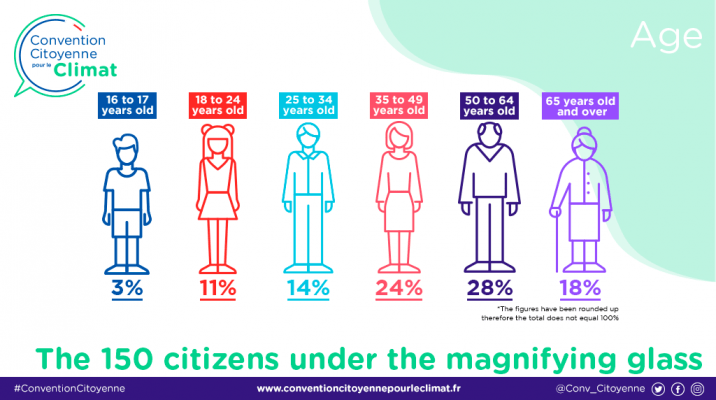
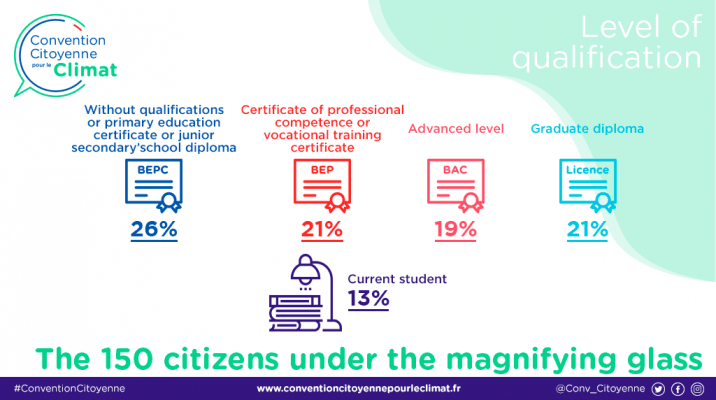
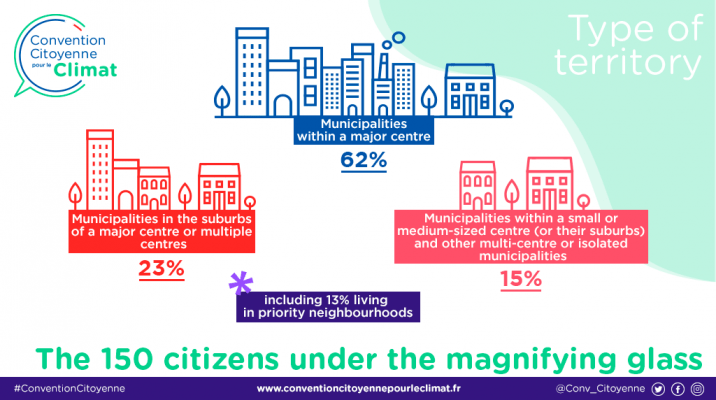
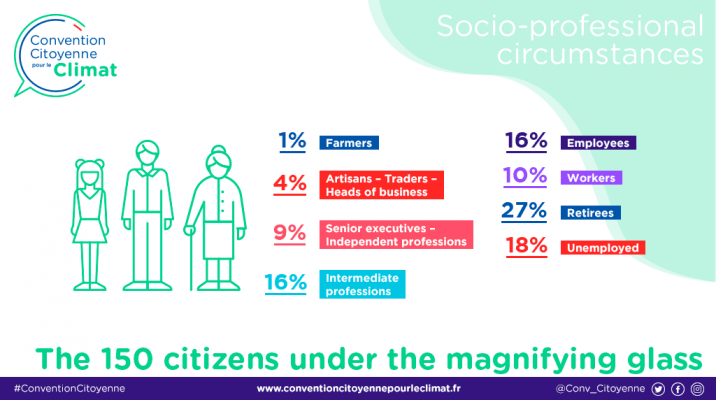
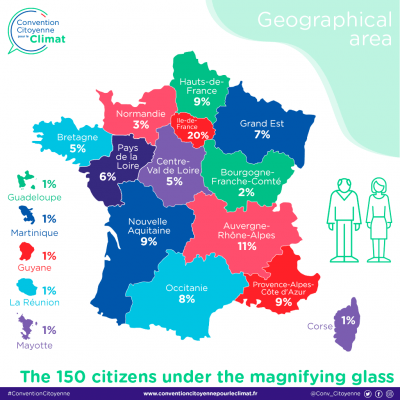
Source: Convention Citoyenne pour le Climat
How did the Convention work?
The ESEC organized it, and a governance committee was overseeing it. Three guarantors were tasked to ensure that the Citizens’ Convention remains independent. They were named by the Senate, the Parliament and the ESEC. Debates between the 150 were supported by professionals in citizen participation and deliberation (I am honestly still wondering why these professionals are not hired by the French Parliament too…). Technical and legal experts were also available to support the 150 in their mandate.
I need to stop a moment to praise that idea:
- Having scientific expert available for citizen information is priceless: they describe facts, not opinion. That’s how you can make your own choices.
- The 150 had to make a great deal of work to learn, reflect on and propose solutions. I know people with master degrees that don’t reach the bottom of what these citizens achieved in nine months (if you know who I know…).
- Randomness guaranteed that none of these citizen were defending political or economic interests.
- Adjusting the randomness to make up a “little France” allowed for people to meet, who otherwise would have never met. Is there a better way to take decisions that will impact all?
- That is a unique experience: where on earth are citizens able to be scientifically and carefully informed, including listening to opposing views, then given the time to think about it and have support of experts to define solutions, and then choose them democratically together?
- And finally: non-technocrats citizen make concrete and straightforward propositions. There are not empty meaning, they just get right to the point.
And this enthusiasm out of the way, here a little graphic that shows you how things went the past 9 months:
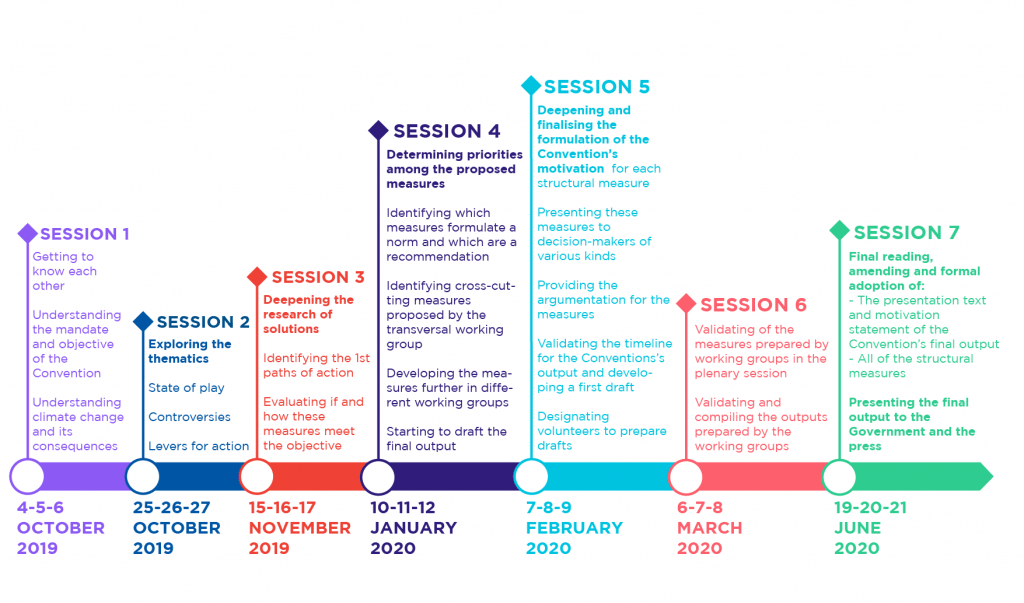
Source: Convention Citoyenne pour le Climat
The purpose of the Citizens’ Convention
As mentioned at the beginning of this Note, the 150 were mandated to propose actions to reduce greenhouse gas emission from at least 40% compared to 1990. That is not an easy task. It even appears that the world knows it had to do it since at least 20 years and just keeps postponing. I picture history books in 2 centuries, a chapter called something like “the great procrastination of the century that led humanity to its apocalypse”.
- Anyway, why 40% by 2030? That is the strict minimum for France to try to implement the Paris Agreement. The same Paris Agreement that tries to minimize the casualties of climate change by trying to get countries on board to try to limit global warming at 2°C. That a lot of tries, but one has to.
- Coming to why 1990: that’s an international year of reference that countries finally agreed upon, more or less based on the Soviet Union collapse. Consider 1990 as the ground zero of the environmental crisis. Yes, the numbers add up: it’s been 30 years of crisis, and ain’t getting any better.
So, the 150 proposed 149 actions to try to solve that little problem we have. A lot of these actions have already been translated into legislative terms in their final report, that the government or parliament could pass into law or . Every proposed action contributes to achieve a goal. Each goal belongs to a group, or ‘family’ and each family belongs to a theme. There are:
- 5 themes
- 22 families
- 43 goals
- 149 proposed actions
I will definitely share these 149 actions, because they are great and inspiring. But that’s for the next environmental note.
Prior you digest all of the above, I really want to highlight this:
The Citizens’ Convention on Climate was a great idea and the work of the 150 is tremendous. It is fact based, it is brave, it is realistic, it takes everyone on board.
To reiterate: it took only 9 months for 150 citizens to develop a plan that France should have started to implement years ago. We would have start sooner, most of the proposed actions would have been less radical. But now they have to be because we have so little time left. The 150 citizens did the job they were mandated to do, and in their final report you can feel a true sense of community, respect, consciousness of the emergency and the need for immediate action. I am so thankful to them.
However, there is one big risk: all of it for nothing. Some of the major actions have already been declined. I am as enthusiast for the Citizen Convention on Climate as I am upset that proposed and needed actions might never be implemented. And we do need them.
Despite that risk: some of the actions proposed can be implemented locally, by private companies, by not-for-profit organizations, by families. So let’s do them without further a due. I also trust this experience should be replicated in other countries. Actions to fight against and adapt to the climate crisis has to be developed by and for the citizens: I hope the Citizen Convention on Climate will inspire others.
Keep posted for the 149 propositions, I am already so excited to share them with you. Should you read French, you can find them here.
Resources:
In French:
The final report of the 150: https://propositions.conventioncitoyennepourleclimat.fr/pdf/ccc-rapport-final.pdf
The face of the 150:https://www.instagram.com/avecles150/
The 149 proposed actions: https://propositions.conventioncitoyennepourleclimat.fr/
In English:
The Citizen Convention on Climate’s website: https://www.conventioncitoyennepourleclimat.fr/en/
The Economic, Social and Environmental Council: https://www.lecese.fr/en
 Les Notes à Béné
2 thoughts on “The Citizens’ Convention on Climate – episode #1: origin, purpose, and how it worked”