
In a former episode of this series, it has been explained that the French Citizens’ Convention on Climate final work presents five themes defining field of actions to reduce CO2 emissions. One of them is “consumption” and is divided into five “families” of goals, which are:
- advertising displays
- advertisement
- overpacking
- education
- monitoring and control of environmental public policies
→ Reminder: I have compiled the full list of proposed actions translated into English here.
In this episode, I will focus on the “family” called advertising displays and its one and only goal numbered C1: Creating an obligation to disclose the carbon impact of products and services.
This goal is built upon the following consideration: “all consumers should be able to easily learn about and trust the information on environmental impacts that are related to the consumption of a product”. According to the 150 citizens of the Convention, advertising displays “seem to be an efficient and relevant solution to provide a quick and intelligible overview to consumers, that would allow them to freely choose the product they purchase while being informed about the upstream impacts of a product or a service”.
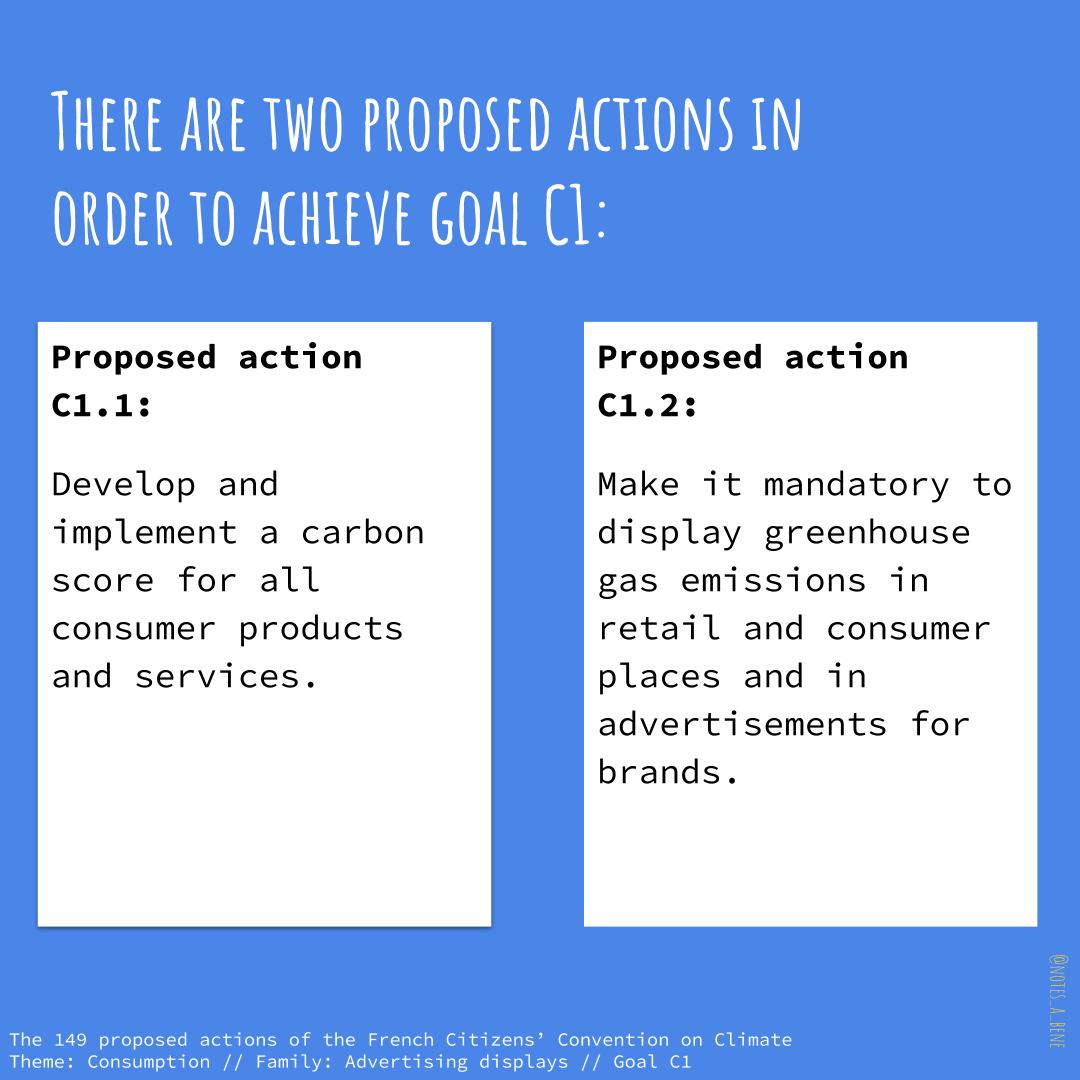
Let’s deep dive into this goal, which presents two proposed actions:
- C1.1.: Develop and implement a carbon score for all consumer products and services.
- C1.2. Make it mandatory to display greenhouse gas emissions in retails and consumer places and in advertisements for brands.
These two proposed actions are interdependent, which makes totally sense: you definitively need a reliable carbon score (e.g. CO2 equivalent, a metric used to bring under one umbrella greenhouse gas emissions) prior making it mandatory to display greenhouse gas emissions in retail stores and advertisements.
So, I understand that this goal, if achieved, should help you solve the difficult riddle when doing your grocery: what does produce more carbon emissions between organic tomatoes from Spain (providing that you live in France) wrapped in plastic or the non organic tomatoes sold in bulk coming from a local farmer? Or a more straightforward one when going shopping: between a ZARA T-shirt made in Bangladesh or a 1083 (a French brand) T-Shirt made in Northern France?
NB: a carbon score for food products is in my opinion not a decisive information to buy or not to buy. It is ‘just’ an additional information so consumers can have more information to choose their product. Let’s take tomatoes: maybe carbon emission are not something that is crucial for you when you do your grocery. Indeed, maybe you’d rather not eat pesticides and/or not participate in the extinction process of insects (including bees). In that case, organic tomatoes might be the right choice for you. On the other hand, maybe you’d rather support a local farmer whom you know is not making his/her tomatoes take a bath of glyphosate, though is not certified organic. (Not sure if I am the only one having a hard time doing grocery in supermarket and ends up buying no tomatoes?)
So, in short: a carbon score wants to provide the consumers with more information so they can make (a more) conscious choice on what they buy.

This goal has some background and is based on what already exists in France:
- a law on energy transition and green growth (la loi sur la transition énergétique et la croissance verte) that requires enterprises and public institutions to calculate their carbon footpring every three years (and every four years for private companies). Since 2016, the resulting carbon footprint report has to be published online and made accessible to the general public on the French energy and environment agency website
- a law on circular economy from February 2020 (passed while the Citizens’ Convention on Climate was working on the proposed actions), that foresees the implementation of a voluntary environmental information display on services and products.
- Online tools to estimate the carbon footprint of different products, services or enterprises.
So why proposing to do more? According to the 150 citizens, carbon footprint reports are not visible and easily accessible so consumers can be really informed. Indeed, very few people know that these reports (when they have been done) are available online. The law on circular economy that foresees the display of environmental impacts is for now voluntary, and does not focus on carbon emissions. Finally, the available tools online to estimate carbon footprint are not widespread, nor do they apply the same methodologies and therefore make the numbers hard to compare.
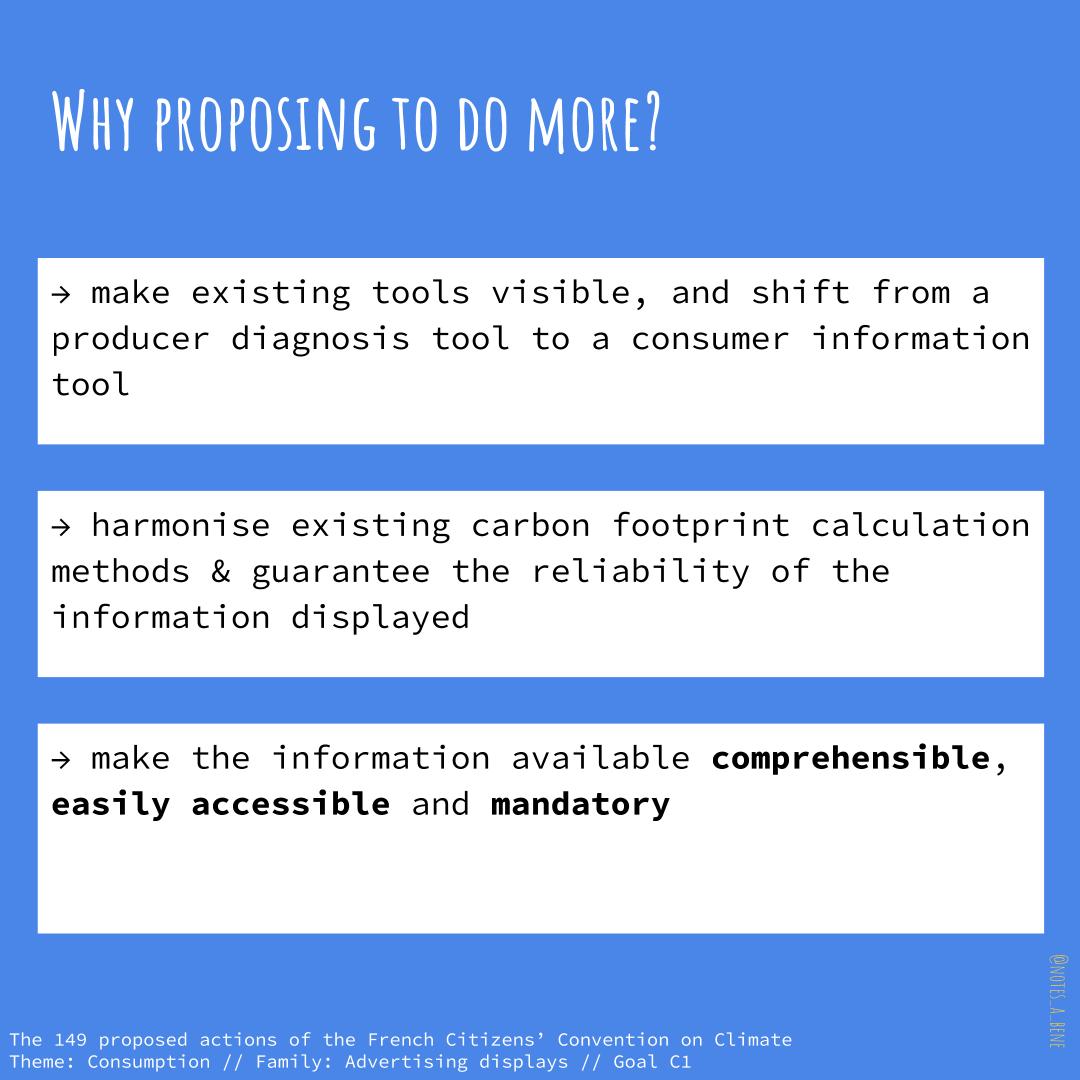
At the end of the day, goal C1 aims at making visible and obligatory facilities and mechanisms that already exist.This could be done by using the carbon footprint that private enterprises and public institutions have to provide and make it shift from being a seller/producer diagnostic tool to a consumer information tool. To do so, the resulting carbon score should be displayed in retail stores and advertisements, but also visible and understandable to the great public, so that is easily accessible and comprehensible to all consumers.
In order to concretely achieve this proposition, the idea is to amend the law on circular economy passed in February 2020. The proposed amendment requests that the environmental information displayed highlights the carbon impact of the products, considering the whole life cycle of the product or service. In addition, the 150 citizens recommend that a public organization is being designated to ensure that the display of carbon impact is implemented, and the data used to establish that impact, reliable.

Presented like that, it seems simple: let’s quickly amend a law and we’re done. But there are some difficulties, of which the 150 citizens are aware of and have proposed solutions for. The first difficulty is the development and implementation of the methodology to implement a carbon score. Indeed: can we use the same evaluation frame for shoes, a laptop and tomatoes? In addition, collecting data to calculate carbon emissions is a struggle, since they are not necessarily available. Finally, carbon emissions calculations can greatly change according to the scope of the study(usually a life cycle assessment – LCA)
Are methodology struggles of life cycle assessment (LCA) one of the challenges to implement a carbon score? A LCA allows to establish the environmental impact of a product, including (but not limited to) carbon emissions. Ideally, a LCA takes into consideration every step of a product’s lifespan, including raw material extraction, manufacturing, transport, storage, freight, retail, use and finallywaste disposal. However, when conducting an LCA you are kind of forced to define the scope, e.g. define some limits to your assessment. For example, when extracting rare earth that will go into a smartphone, you could consider to take into account the carbon emission produced by the excavator used in the mine (the manufacturing and use of that excavator). But by doing so, you would definitely fall into an endless process. So, to avoid that problem you have to define limits – and be transparent about it. Maybe you’d ignore the environmental impact of the excavator, maybe you’d just consider the fuel used for it, or maybe an excavator’s LCA already exists and you’d re-use the data from it. That implies some risks: if you’re ignoring the excavator, you are ignoring CO2 emissions of this production step. If you just count the fuel or use the data from another LCA, maybe it is not the same excavator model – maybe the one used in this other LCA pollutes way more? This kind of examples will add up at each step of the LCA and that is one of the reason why it is difficult to get reliable and comparable data. However, LCA is a well known, always being improved and I trust (?) one of the best method available as of today. Also, LCA software are getting better that allow to adjust a lot of different variables. Taking the excavator example again: existing data and available software allow to model the reality as close as possible, even if you don’t have the data available: the model, the fuel used, the fuel efficiency… so even if you don’t have the exact data, you can adjust the variables to get as close as possible from reality. In short: it’s difficult, but not impossible, and every day easier.
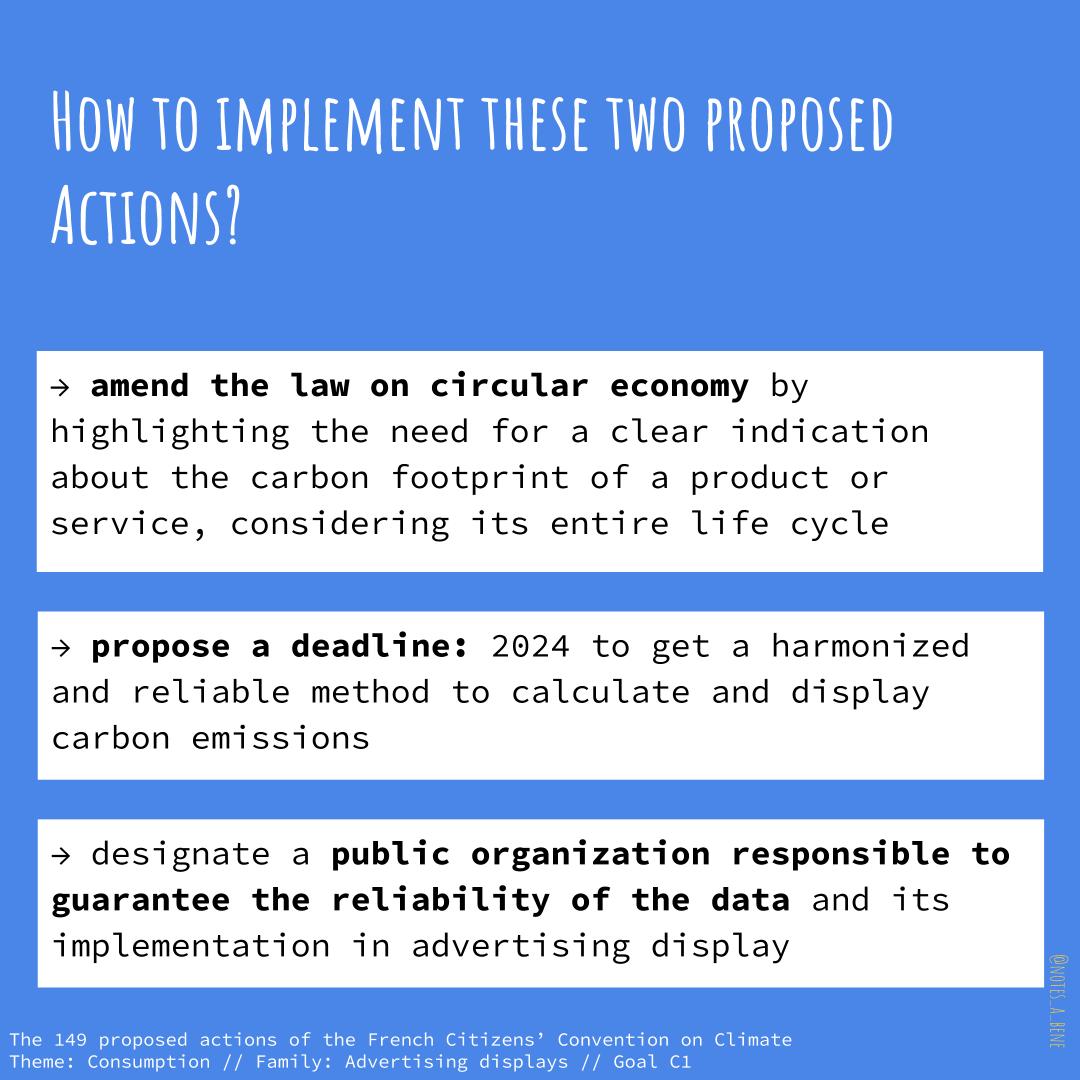
Consequently, the 150 citizens are asking for a scientifically reliable and harmonized method of environmental display by 2024. This is a necessary step to realize the proposed action of getting every companies to display their carbon emissions,but also pushes other French and European initiatives to deliver.Note that for some industries, methods are already available and reliable – for example textile, shoes and furniture industries.
A last challenge, specific to France: a carbon score system could have a negative impact in the French overseas regions, as prices could evolve based on that carbon score…which might automatically get worse for imported products (from France to French Guyana, for example). Therefore, a feasibility assessment for these regions is recommended by the 150 citizens prior the implementation of the proposed action C1.2 (e.g. make it mandatory to display greenhouse gas emissions in retails and consumer places and in advertisements for brands).
98% of the 150 citizens selected at random agreed on creating an obligation to disclose the carbon impact of products and services. At the end of the day, they are not proposing a revolutionary action, but the optimization of what already exists, a deadline and consideration for French overseas regions. Goal C1 and its proposed actions could influence enterprises to find more efficient and less polluting way to produce since the carbon score would be an additional information for the consumer to choose between two products or services.
As of today, these two proposed actions have not been studied by the French parliament, according to #sansfiltre, a tool set up by the 150 citizens organization that monitors the status of all the Citizens’ Convention on Climate proposed actions, which President Macron promised to support (at least most of them, see episode #2 of this series).
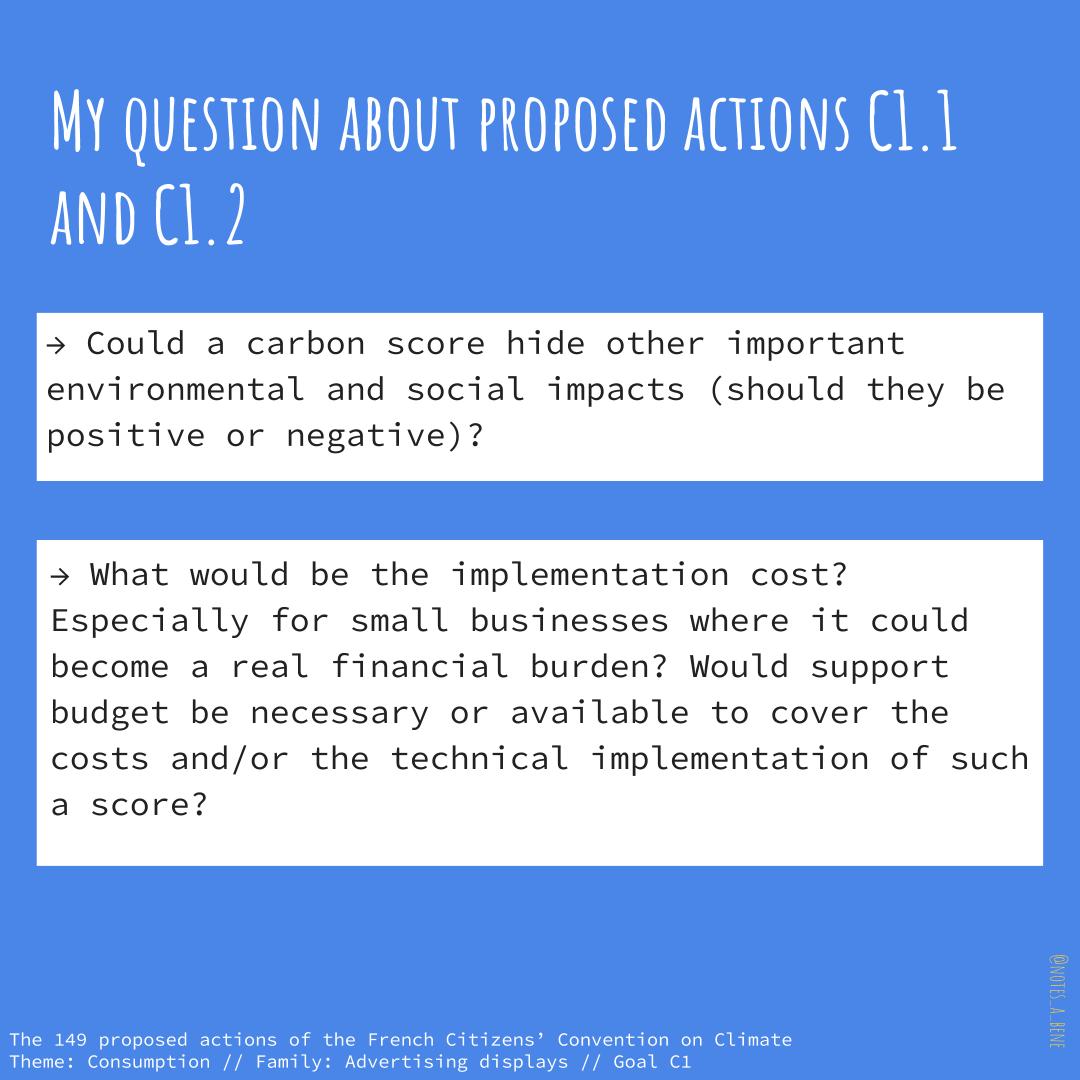
I like the essence of these two proposed actions, yet I have two questions: could some small business be negatively impacted by a carbon score? Indeed, sometimes economy of scale allow a lower carbon impact per unit of product (not per volume). A carbon score could “overfocus” on this environmental aspect, while small business can have other positive environmental and/or social impacts. The second question, or rather a concern, also for small businesses: calculating carbon emissions can be costly in terms of time and money, and is quite technical –small business might need some financial and/or technical support to implement such a score.
If you read French, some resources are linked below:
*Le rapport final de la Convention Citoyenne pour le Climat, pages 16 à 21 pour l’objectif C1 : https://propositions.conventioncitoyennepourleclimat.fr/pdf/ccc-rapport-final.pdf
*Les objectifs de la thématique « Consommer » présentés en ligne: https://propositions.conventioncitoyennepourleclimat.fr/consommer/
*La situation politique des mesures – où en sont les propositions? https://sansfiltre.les150.fr/
*Une vidéo courte et simple expliquant le cycle de vie d’un produit par l’ADEME: https://www.youtube.com/watch?v=SJq7i_3UODM
*Les bilans d’émissions de gaz à effet de serre disponibles en ligne: https://www.bilans-ges.ademe.fr/fr/accueil.
 Les Notes à Béné
One thought on “The Citizens’ Convention on Climate – Episode #3: Creating an obligation to disclose the carbon impact of products and services”