
In the previous episode of this series talking about the outcomes of the Citizens’ Convention on Climate, I introduced the first goal (numbered C1) of the theme talking about consumption: creating an obligation to disclose the carbon impact of products and services. In this article, I’d like to present the following and related goal (numbered C2): regulating advertising to reduce incentives for over-consumption.
Should you have only 2 minutes ahead of you, just go through the following 10 short and hopefully straightforward slides. Otherwise, you know how to make me happy: continue reading & give me some feedback!


[Should you need a reminder of what the Citizens’ Convention on Climate is all about, check out episodes #1 and #2]
Why willing to regulate advertisement?
Admit it: how many unnecessary things have you bought in your life because advertisements made you do so? You know what I am talking about: you are shopping online, and Amazon is suddenly suggesting awesome products which apparently go together with the single one you attended to buy… And you find yourself obediently adding items to your virtual cart, items which you didn’t know five minutes before you needed them. Oh, and by the way, these are still sitting in the back of your closet. And what about the “two baguettes bought, one free!” Well, the third baguette will be hard before you know it, and will be thrown away (this example might only work for French people though, but you can picture that ad with donuts or bretzels can’t you?). And a classic: you got enough customer points to buy a new smartphone at a good price while your current smartphone is still up and running? But it’s so shiny and will make so great pictures for your 90 instagram followers (not talking about me)! Sooo… the functioning current smartphone of yours will bring company to your other electronic items in that box that is already full of charger cables, headphones, batteries and other e-craps, to let room for the unneeded but new smartphone in your pocket.
And don’t tell me you don’t have that e-crap box, I won’t believe you. Mine is a full old shoe box. The worst thing about it is that even this shoe box comes from shoes I just wore twice or so. (#Ipleadguilty)
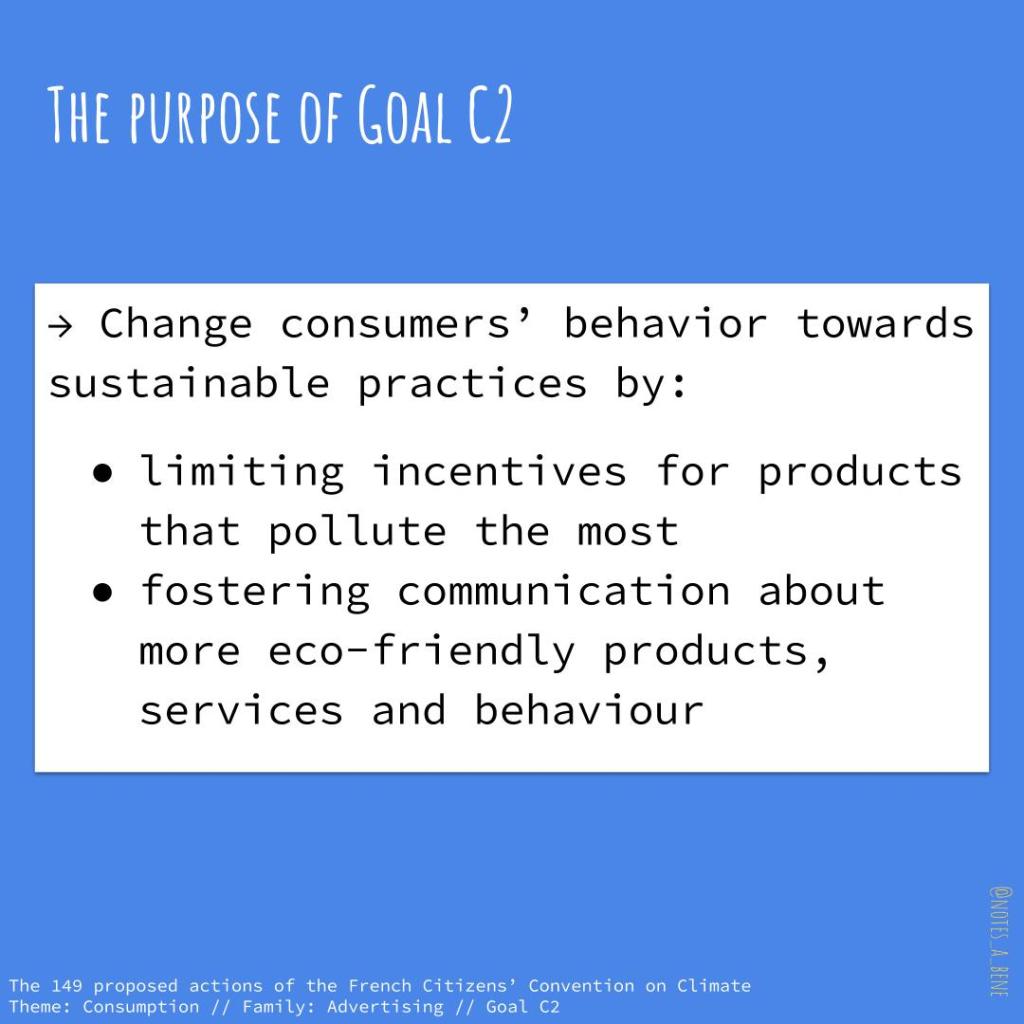
Thus, the purpose of goal C2 is to help me, and you, to reduce pollution related to overconsumption. One could consider that each product we buy which we don’t really need creates unnecessary pollution. But the problem is: one is constantly bombarded by needs and desires which are created for us to buy. And we all fall for it…
A (very) quick overview on how is advertising regulated in France
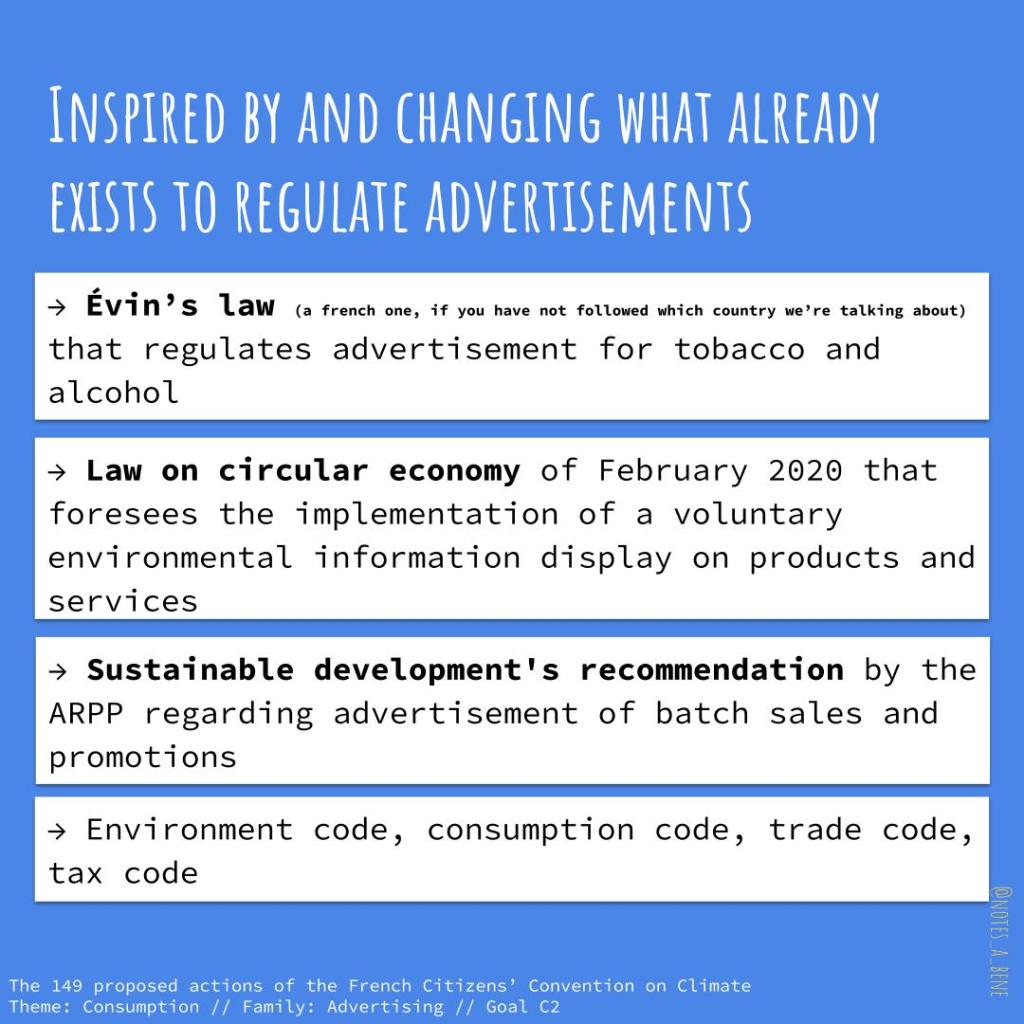
France has a bunch of laws and measures to regulate advertising, especially for products considered as dangerous/unhealthy: tobacco, alcohol, some processed food… These laws and rules are to be found in different codes (collection of laws and rules): the environmental code, the consumer code, the commercial code or the general tax code.
Particularly, we have the Èvin law regulating ads for alcohol and prohibits the ones for tobacco. In addition, since 2004 almost every advertisement for processed food has to make a sort of disclaimer along the line of: “for your health, try to not eat food that is too fat, too sweet or too salty”; “for your health, you should work out regularly”.
On the sustainability side, a law on circular economy and waste has been passed in February 2020 and foresees the implementation of a voluntary environmental information display on services and products. Also, the professional advertising regulatory authority (in french: autorité de régulation professionnelle de la publicité – ARPP) has developed sustainable development guidelines for advertisements.
So, what’s the link between advertisements’ regulations and reducing incentives for overconsumption?
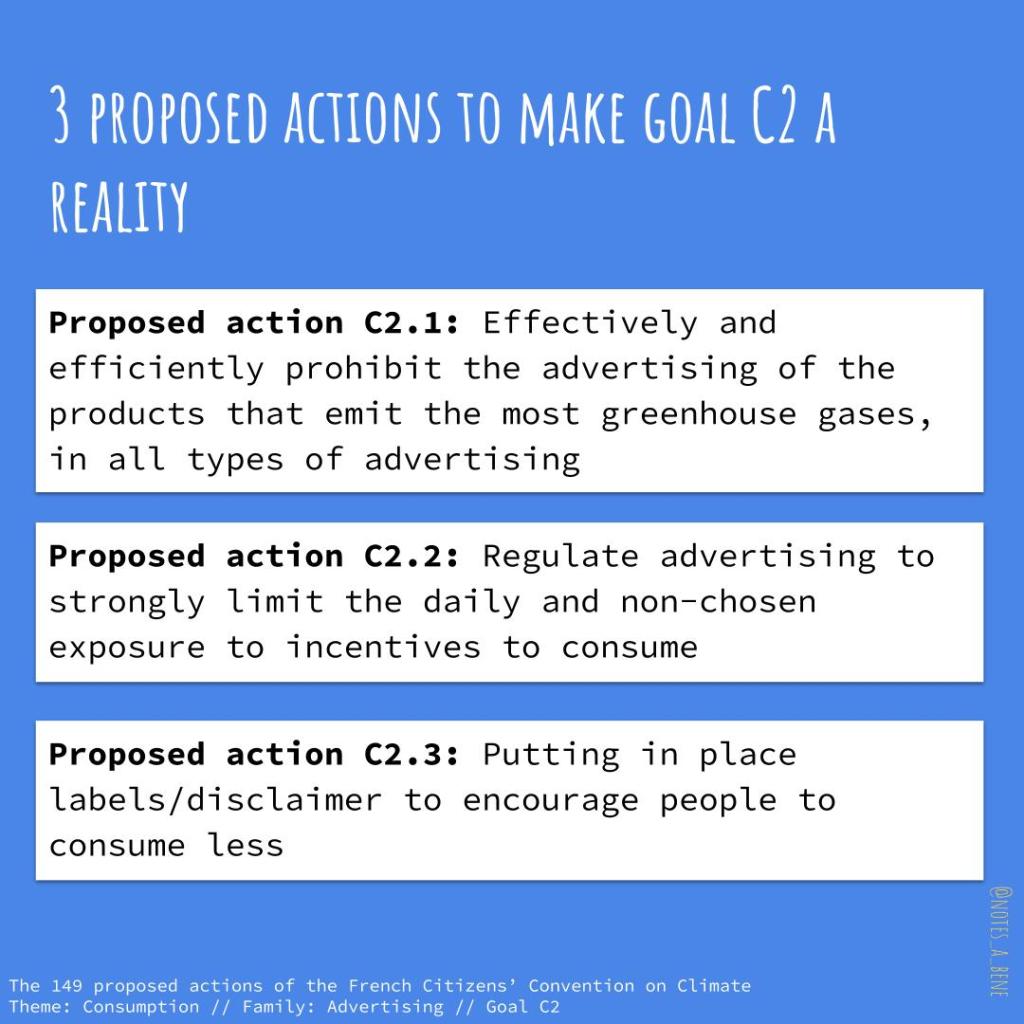
The 150 French citizens picked at random to participate in the Citizens’ Convention on Climate propose to use mechanisms that already exist and extend them to products that pollute the most. To do so, this goal (e.g. regulating advertising to reduce incentives for over-consumption), is made of three proposed actions:
- proposed action C2.1: Effectively and efficiently prohibit the advertising of the products that emit the most greenhouse gases, in all types of advertising
- proposed action C2.2: Regulate advertising to strongly limit the daily and non-chosen exposure to incentives to consume
- proposed action C2.3: Putting in place labels/disclaimers to encourage people to consume less.
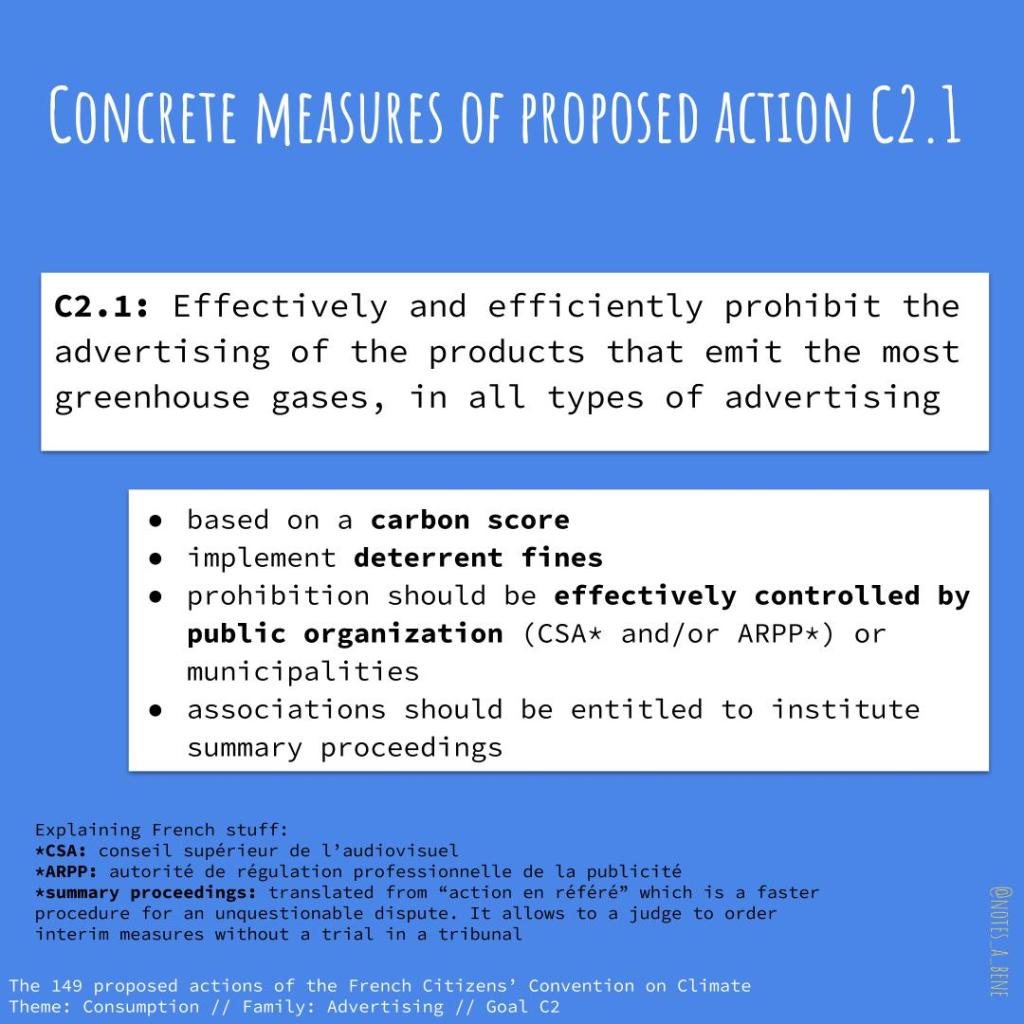
Focus on proposed action C2.1: Effectively and efficiently prohibit the advertising of the products that emit the most greenhouse gases, in all types of advertising
Since pollution does indeed damage our health (directly or indirectly) in a similar way as tobacco and Kalashnikovs (weapons ads are also banned in France – this is so obvious to me I forgot to mention), it seems reasonable to want to abolish advertising for the products that pollute the most. But how?
- By 2023, ban on all advertising media (television, radio, paper, internet and physical signs, telephone and SMS, e-mails, etc.) products with a high impact on the environment.
- Put in place means for reinforced control and effective compliance with the rules, accompanied by financial penalties that are sufficiently significant to be an incentive.
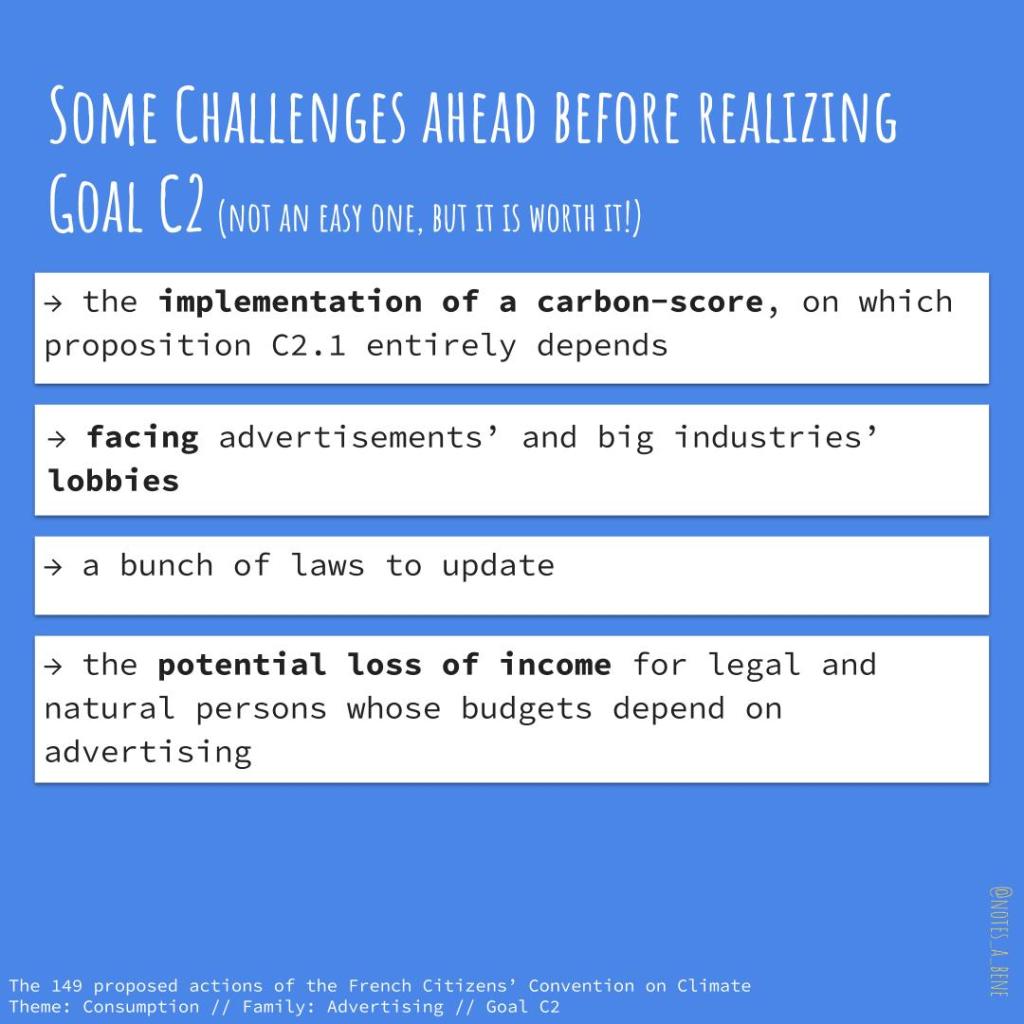
Ain’t a joke. One of the challenges to implement this proposed action is that it depends on the realization of goal C1, which is to create an obligation to disclose the carbon impact of products and services (see episode #3). Without that carbon disclosure, it is difficult to determine a threshold in order to ban products from advertisements.
Focus on proposed action C2.2: Regulate advertising to strongly limit the daily and non-chosen exposure to incentives to consume
Proposed action C2.2. tackles advertisement in general, not only the one of most polluting products. Ideas to implement that action are ambitious and come with a batch of bans:
- prohibit analog signs and digital advertising screens in outdoor public spaces, except for local, cultural advertisements and road signs for shops/malls directions
- limit advertising in the digital space, i.e. systematically offering paid access without advertising or free access with advertising, and/or making ad blockers as a default setting in web browsers
- prohibit the placing of paper ads in letterboxes from January 2021 onwards
- ban advertising aircraft
- prohibit advertising for consumption patterns such as batch sales, price reduction, sales (note: we are talking about banning advertising of, and not the practice of batch sales, as the 150 citizens emphasise the importance for some households to have access to products at reduced cost).
- make the distribution of free samples an offer on demand rather than a systematic one
- regulate television/radio/internet games by banning the winning prizes from being products with a high environmental impact (for example, a big car)
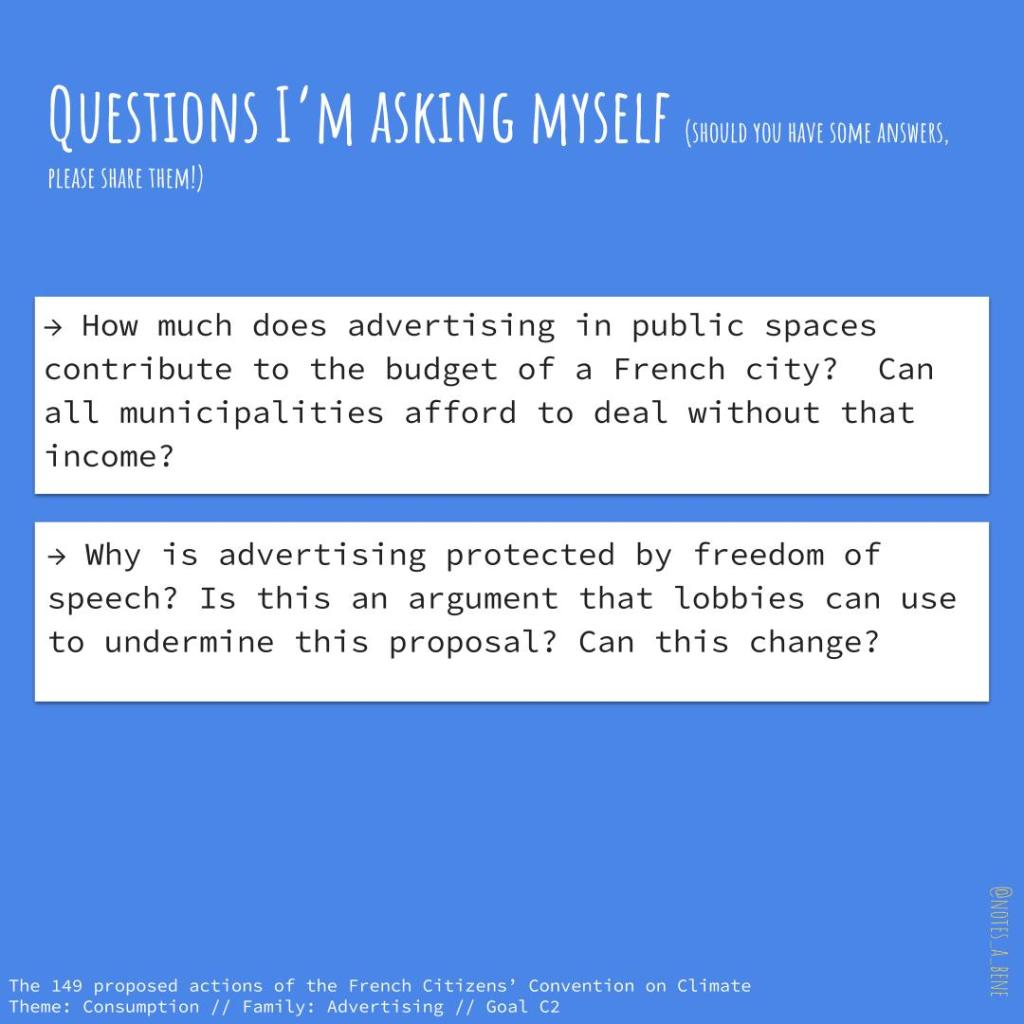
However, the legislative committee (which supported the work of the 150 citizens) warns in the final report of the Convention that some of these ideas would be difficult to implement as they are potentially unconstitutional. Indeed, advertising is protected by the principle of freedom of expression and by the principle of freedom of trade and industry. Therefore, it is necessary to have a strong general interest objective in order to argue for the implementation of certain measures (one would think that minimising the environmental crisis is one of them). Reportedly, a ban on offering certain products in the winning prizes of a TV or online game could be unconstitutional, as it could be considered disproportionate compared to the general interest objective. Apparently, this would also apply to banning the distribution of advertising in letterboxes, that could be seen as jeopardizing the freedom of trade and industry.
Other ideas listed above may be challenging to implement as well. This is the case with the banning of billboards and advertising screens, as these are subject to local taxes. Finally, the modification of the environmental code to implement these ideas leads to the update of others, such as the highway code and the tax code.
Let’s talk about my favorite proposed action: putting in place labels/disclaimer to encourage people to consume less (C2.3)
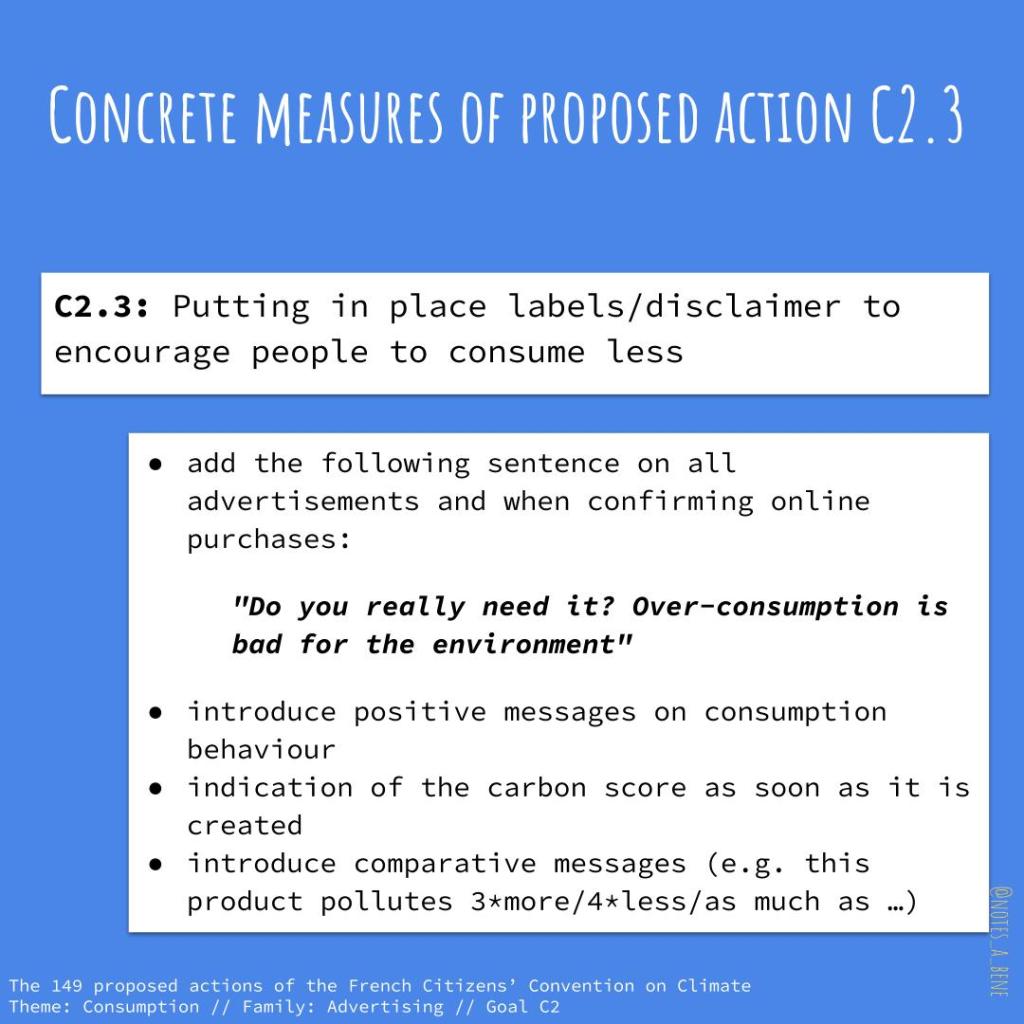
The 150 citizens would like to introduce similar warnings that are on cigarette packaging in most European countries: “smoking clogs your arteries”; “smoking causes mouth and throat cancers”, ect. But be eased, these warnings would not be as anxiogeneous. Though it could have been and it would not be a lie to write: “this t-shirt is endangering the lives of bangladese women” or “overconsumption is putting the life of your children at risk”. No, the idea is way more friendly and would be to put on every ad something like: “Do you really need it? Over-consumption is bad for the planet”. This sentence would also be mandatory to ask prior confirming online purchases. My gut feeling says that big companies won’t like it at all. Picture Amazon’s boot, just before you click on “buy”: “are you sure about that? Because I tricked you, you got 3 items you did not attend to buy and I managed to manipulate you so you add them to your cart. As a fairplay company caring for your wallet and the environment, I will ask you again: are you sure you wanna buy everything on that list?”.
This would be brilliant.
Closing remarks
89.6% of the 150 citizens who were picked at random to participate in the Citizens’ Climate Convention voted in favour of regulating advertising to reduce incentives for over-consumption. Getting it into law and implementing it is not going to be easy as it could have consequences on the advertising revenues on which many legal or natural persons depend. This is why the 150 emphasise that they do not want to abolish advertising, but to redirect it towards more environmentally friendly products and more virtuous behaviour. As for the economic impact of companies that would be deprived of advertising… It could encourage them to change their production practices in order to be entitled to advertising. And at worst, let’s be honest: no matter how regulated the advertising of unhealthy products may be, we are still left with industries that are (very) well functioning economically. Yes, I am not worried about the economic well being of the sugar, weapons, tobacco and alcohol industries.
Regulating advertising would simply be a lever to consume less, but better. Perhaps it would even indirectly increase French population’s purchasing power for local products (usually a little more expensive), and thus support the French economy. Isn’t a unifying argument?
I have listed all the proposed actions of the French Citizens’ Convention on Climate here:
 Les Notes à Béné